TUFF BEATS ONLINE STORE
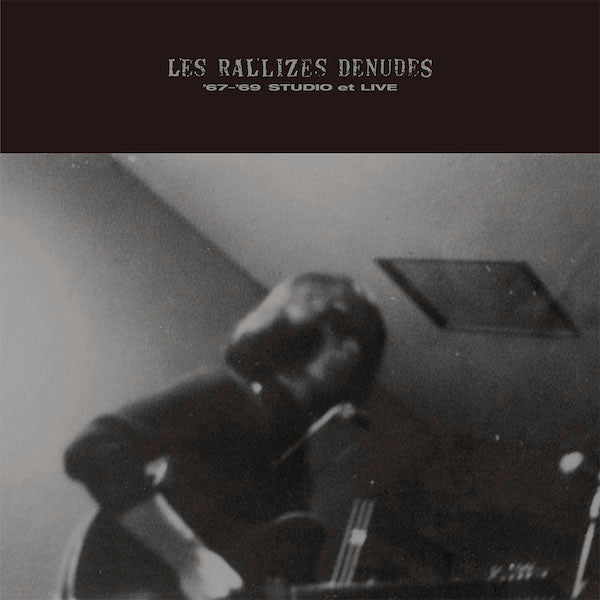
Les Rallizes Dénudés / '67-'69 STUDIO et LIVE (CD)
Les Rallizes Dénudés / '67-'69 STUDIO et LIVE (CD)
Couldn't load pickup availability
The long-awaited reissue of the rare recording collection "'67-'69 STUDIO et LIVE," which captures the fresh and vivid image of the Naked Rallizes band in their early days, has been newly remastered and includes two unreleased bonus tracks!
Originally released in August 1991, the original album by Les Rallizes Dénudés, "'67-'69 STUDIO et LIVE," has been reissued with two previously unreleased bonus tracks! This is a valuable collection of recordings from the early days of their band, packed with the electric guitar feedback that would determine their future direction.
*This product is scheduled to ship from Friday, October 28th onwards.
----------------------------------
[Explanation of Naked Rallizes "'67-'69 STUDIO et LIVE" by Manabu Yuasa]
This is a reissue of "'67-'69 STUDIO et LIVE," originally released in August 1991. It features rare recordings from the earliest days of Rallizes Dénudé. The tracks were selected and edited by Takashi Mizutani. For this reissue, the recordings were re-examined to use the best available recordings, and the album was remastered by Makoto Kubota, a former member of Rallizes Dénudé. The CD version also includes two newly discovered bonus tracks.
In the fall of 1967, Takashi Mizutani and Takeshi Nakamura, who knew each other from the light music club at Doshisha University in Kyoto, decided to form a band. Nakamura apparently approached Mizutani. Mizutani had unusually long hair at the time, giving him a unique presence. Both played guitar, so they began looking for a bassist and drummer. However, they didn't hold auditions by listening to performances. They simply looked for someone cool, someone who clicked with them intuitively. That's how they found Moriaki Wakabayashi, who was also attending the same university.
"We decided to form a band that would revolutionize the Japanese music scene."
Wakabayashi says (Interview published in October 2017 on Buzz Feed Japan, interviewer: Kanba Ryosuke).
The three hit it off right away. Wakabayashi says that when they approached him, he had heard about the "October 8th Haneda Struggle" and was thinking about confronting society. "October 8th" was a protest movement in which approximately 2,500 people, mostly university students, gathered around Haneda Airport to block Prime Minister Eisaku Sato's visit to Southeast Asia and Oceania, including South Vietnam, and clashed with 2,000 police officers, resulting in the death of one Kyoto University student. This was a time when expressions of distrust in the government and anti-war movements against the Vietnam War were growing day by day. Wakabayashi then expanded into Zenkyoto activities.
Various radical acts of protest were occurring daily in cities around the world. Political and cultural activities were occurring simultaneously. Various people were translating their protests and dissent against the dogmas and authority of the old order into actions, behaviors, and works. This movement, a culture of spontaneous protest, a counterculture, was expanding worldwide. From 1967 to 1968, it expanded rapidly, bringing about diverse changes across literature, art, music, film, and other genres. The "Langlois Affair," in which French filmmakers rallied in January 1968 to protest the unilateral dismissal of Henri Langlois, director of the Cinémathèque Française, by French Minister of Culture André Malraux, canceling screenings and demonstrating, could be seen as a precursor to this movement. Four months later, in May 1968, the May Revolution occurred, in which the intensifying student movement in Paris spread to a general strike across France. Some were involved in anti-war activities, some in political struggles, some in environmental protection activities, some in performance art activities, some in sound performance activities, and some in street theater activities; each was devoted to their own unique form of protest.
The formation of Naked Rallizes was a response to this global movement.
Although they hit it off, Wakabayashi had no experience playing an instrument. According to Nakamura, "From the beginning, sensitivity and ideals were more important than instrumental technique." Mizutani likely felt the same way. Later, while the three were walking around the streets of Kyoto, the idea of the band "Rallizes" came to mind. Wakabayashi says that the "naked" part was to indicate a lack of pretense, and was not a reference to William Burroughs's "Naked Lunch."
Takashi Kato, a jazz drummer and Nakamura's high school friend, was selected to play drums, and the four practiced in a warehouse in Kusatsu, Shiga Prefecture. Initially, without any original songs, they practiced songs like the Blues Magoos' version of "Tobacco Road." Their unique approach to the song is evident in their decision to base their performance on the wild Blues Magoos version rather than the hit Nashville Teens version. The bonus track on this reissue CD features "Tobacco Road" by Mizutani, Nakamura, Wakabayashi, and Kato. This is likely the earliest recording of the "original Rallizes Nude." Wakabayashi left the group in early summer 1968 due to his devotion to political activism. This recording dates to the spring of 1968. According to Wakabayashi, the group's first performance was at a dance party hosted by the Doshisha University Photography Club. The performance was arranged by the woman who shot the photo featured on the cover of "'67-'69 STUDIO et LIVE." This was before they had even written any original songs. It was probably the spring of 1968, around the time of the May Revolution in France. At one point, Wakabayashi sang the Rolling Stones' "As Tears Go By." Even after leaving the band, Wakabayashi often met Mizutani and the others on campus or at their hangout jazz cafe, Cianclere.
"Smokin' Cigarette Blues" on this album was recorded live at Doshisha University's school festival in the fall of 1968. The performance took place in a large classroom used for general education courses at Doshisha University. A thunderous sound filled the dimly lit room. Mizutani, Kato, and Nakamura were playing bass. Mizutani's guitar roared in a completely improvised performance.
This performance is a strong testament to Mizutani's statement in a fax interview published in the November 1991 issue of Music Magazine that "the moment Mizutani's electric guitar feedback came back, the direction we should take was decided." It's clear that the foundations of the band's 30 years were already being laid just one year after the band's formation. Was there any other band in Japan that performed like this in the fall of 1968? Harmonica playing unfolds in the latter half of this song, courtesy of Wakabayashi, who joined the band on the spot.
Mizutani was a member of the poetry research group at Doshisha University. He had been writing poetry even before the band was formed. After Wakabayashi left the band, Takashi Tada joined on bass, and original songs began to take shape one after another.
The Naked Rallizes also had a close relationship with Kyoto's only underground theater company, the Gendai Gekijo. Rather than simply providing accompanying material for theatrical performances, the theater company and the Naked Rallizes had a collaborative relationship. The Gendai Gekijo had reportedly been involved in light art using strobe lights, black lights, and mirror balls since the spring of 1967. It's likely that light art became a key element of the Naked Rallizes through their collaboration with the Gendai Gekijo. The Gendai Gekijo was founded in December 1962, and its organizer, Tatsuo Komatsu, had been involved in numerous art events in addition to theater performances since the early 1960s. He was a poet, director, playwright, and pantomime performer. Komatsu had a negative view of established theater and theater. His productions were characterized by a high concentration of happenings. In this respect, there was no doubt a common sensibility between the Naked Rallizes and the group, who excelled in improvisation.
"Komatsu's theory was, 'Rather than limiting my activities to the field of theater, I want to maintain contact with a wide range of fields, including film, music, dance, and visual arts, and aim to create a truly comprehensive art form through fierce competition between them.'" (Ota Yoshiro, "Spring's Asura: An Introduction to Komatsu Tatsuo," in "Dreams in the Wilderness: A Collection of Memorial Works for Komatsu Tatsuo," Sunlead, 1987)
As for performances at the Gendai Gekijo, it has been revealed that Mizutani Takashi/Naked Rallizes provided the music for PALODY or the Fantasy of the Rosicrucians, written and directed by Yanagisawa Masashi, which was performed at Play Spot Kyoto in November 1968 and was well received.
On April 12, 1969, the Naked Rallizes performed at the "Barricade A Go Go" event, held in a barricaded classroom in the Faculty of Liberal Arts at Kyoto University. This was one of the "Bali Festival" events, and Komatsu was in charge of the practical operations. Komatsu recalls the "Bali Festival" as follows:
"The Naked Rallizes sang, the bandwagoners who had timidly arrived in Bali were dancing wildly, Ichiro Araki, who had just been released on bail after being arrested for obscenity, sang and played guitar, private film screenings were held, and a series of happenings were held by artist groups such as Play and Zero Dimension. To top it all off, a group of Yamato-style hippies called the Tribe flocked in from all over the country, causing a great deal of scorn from sensible sectarians who wondered, 'What on earth is this, two men kissing each other? What on earth does this have to do with struggle?' (But this is the important part.)" (Komatsu Tatsuo, "A Personal Brief History of the Western Auditorium," op. cit.)
The following day, on April 26th, he held a performance entitled "Recital as Indulgence" at a space called "Igita Gallery" in Sanjo Kiyamachi. The performance was planned and produced by Komatsu. "Igita Gallery" was Kyoto's first gallery specializing in contemporary art. In 1969, it was a valuable venue for presenting contemporary art not only in Kyoto but throughout Japan.
A second recital, titled "Recital No. 2 as Indulgence," was held on October 18th at the Kyoto Education and Culture Center. This time, the drummer was replaced by Matsumoto Tsutomu. Makoto Kubota, who saw the performance that day, was amazed at the volume of Les Rallizes Dénudés' performance, later commenting, "It was the first time in my life that I had ever heard such a loud sound." In any case, a student band that held two solo concerts in 1969 was extremely rare in Japan. This must be taken into account, as this was before venues for rock performances such as live music venues had been established. Les Rallizes Dénudés was a special entity.
The bass line for "La Mal Rouge," included on this album, was conceived by Mizutani and recorded at Sagittarius on April 26th. "Vertigo" and "The Last One" were also recorded on the same day, with Mizutani, Kato, and Tada as the members, with Komatsu and Kato providing the shouts on "The Last One." The bonus track on the CD, "R_sonance," likely dates from around this time. "Les Bulles De Savon," "Memories Are Far Away," and "Tori no Koe" were recorded at Kato's home around the summer of 1969. "My Conviction (2nd Version)" appears to have been recorded on October 18th, or perhaps recorded elsewhere specifically for this date. The members were Mizutani and Tada, with Matsumoto Tsutomu on drums.
On "Bird's Voice," Tada played lead guitar after Mizutani requested that he "express the sound of birds on guitar." At the time, Mizutani enjoyed free jazz and San Francisco-style rock. Among his favorite albums was Frank Zappa's "Freak Out!" by the Mothers of Invention. Mizutani also purchased and listened to their first two singles, "Tsurai Ukiyo" (A Painful Ukiyo) and "Motherly Love," released in Japan. There seems to be a connection between "Tsurai Ukiyo = Trouble Comin' Everyday" and Mizutani's "Vertigo." Tada also purchased and listened to "Freak Out!" at the time, recommended by Mizutani. In "Memories Are Far Away," Mizutani plays a kazoo attached to a harmonica holder while playing an electric guitar. "The way it looked was quite innovative," Tada says. Where did the idea for using a kazoo come from? Perhaps it was from "Freak Out!" "Freak Out!" may have been inspired by the album. "Freak Out!" contains many memorable kazoo tracks, such as "Hungry Freaks, Daddy," "Motherly Love," and "You Are Probably Wondering Why I'm Here." Mizutani's perspective and execution in turning these tracks into his own compositions are unparalleled. Both "Memories Are Far Away" and "Bird's Voice" are important songs that would remain in the repertoire of the Naked Rallizes for a long time to come.
"The Last One." This is exactly what Takashi Mizutani and Les Rallizes Dénudés were pursuing. This song continued to be performed throughout his life, with changes in lyrics, melody, and style. Mizutani once said, "All of 'The Last One's' exist as one connected song."
The Naked Rallizes took a break after a live performance at the Ikenobo Hall in the fall of 1969. Takashi Mizutani was 21 years old at the time.
In the aforementioned fax interview, Mizutani responded to the call to "please give a message to both new listeners (who have heard Les Rallizes Nude for the first time through the CD release) and long-time listeners (who actually saw the band live in the 1960s-80s)," to which he replied:
"Even though times change, we (or Rallys) will not change. We will stay and keep moving forward. And if there is a wall between us, let's break it down too."
More than half a century later, Naked Rallys remains and keeps going.
This record is proof of that.
July 2022 Manabu Yuasa
Tracklist
1. Smokin' Cigarette Blues (Live Version)
2. La Mal Rouge
3. My Conviction otherwise My Conviction
Vertigo otherwise My Conviction
4. Les Bulles de Savon
Soap Bubbles
5. Distant Memories
Memory is far away
6. Birdsong
Bird calls in the dusk
7. My Conviction (2nd. Version)
8. The Last One _1969 (Live Version)
-Bonus Track-
9. R_sonance #
10. Tobacco Road #
#Unreleased music
Product information
[CD]
Product code: UBCA-1073
Released by The Last One Musique / Tuff Beats
Release date: October 12, 2022